How long can you go without water?
How long can you go without water, and how many days can a person survive? What heat, activity, illness, age, and food change, plus the early signs of dehydration.
· 8 min read · Preet Mishra
In short
Most people would last only a few days with no water at all, and heat, hard work, illness, and age can make that window shorter. Food still holds some water, and everyday thirst and pale pee are the checks that matter long before any survival question.
There is no personal countdown for a missed glass. With no water coming in at all, public guidance puts survival at a few days. Heat, hard work, illness, and age can make that shorter. Food still holds water, so skipping a bottle is not the same as taking in none.
The short answer
MedlinePlus says that without consuming water, most people would die in three to seven days (MedlinePlus, water in diet). A 2026 model of one resting 75 kg adult, with 43.7 liters of body water assumed, put passive survival at about 3 to 6 days. In that calculation a dangerous loss arrived in about 2.5 days in warm air and about 5.9 days in the cool (Kenefick and Cheuvront, 2026).
One number is a clinical range for most people. The other is a calculation, not a trial that withheld water from volunteers. A review says the same limit more briefly: without water, humans can survive only for days (Popkin, D'Anci, and Rosenberg, 2010).
For an ordinary day, use the water intake calculator or read how to rehydrate fast.
How long can a human go without water
The body is mostly water, and the published shares do not match. MedlinePlus says more than two-thirds of body weight. The National Academies put the average near 60 percent, in a range of about 45 to 75 percent, because people differ in fat and muscle. Women and older adults tend to sit lower (National Academies). Popkin and colleagues describe about 75 percent in infants and about 55 percent in older adults.
There is no spare tank either. Urine, sweat, breath, and stool keep leaving. Healthy adults at rest stay within 0.2 percent of body weight over 24 hours, by drinking and by letting the kidneys adjust. Stop the intake and those losses do not stop.
Food changes the chart before any survival figure does. About 20 percent of an ordinary day's water comes from food, and about 80 percent from drinks. MedlinePlus counts soup, milk, tea, coffee, juice, water in solid food, and a little water made by metabolism. Someone who is still eating is not in the "no water at all" case.
How long can you survive without water
Heat and hard work move the number more than almost anything else. In hot climates, daily sweat often runs past several liters. Very active people in continual heat often need six liters or more of total water a day. That is hard work in heat, not a desk day.
The 2026 model stayed at rest. A 10 percent loss of body mass, about 17 percent of that adult's body water, is where blood sodium and volume reach or approach values linked with fatal high sodium and with shock. Time to that loss was about 2.5 days near 32 °C, about 5.9 days near 4 °C, and about 3 days with gut losses. Hard exercise and a child in a hot car sat outside it.
Hard exercise and heavy sweat, if you do not replace the fluid, can run from heat cramps to heatstroke, and heatstroke can be deadly (Mayo Clinic). The CDC asks for extra care on hot days if you work or exercise outside, are 65 or older, are an infant or young child, or are pregnant or living with heart disease (CDC, heat and your health).
Illness, age, and some medicines shorten the margin. The NHS lists diabetes, vomiting or diarrhea, heat, too much alcohol, heavy sweat, fever, and medicines that make you pee more (NHS, dehydration). Young children often cannot say they are thirsty. At that age the most common cause is diarrhea and vomiting (Mayo Clinic). Older adults start with less body water and feel thirst later. The CDC says not to stop a medicine for the heat until you have talked with a clinician.
What the body does as water falls
Urine gets darker and smaller. When it is as concentrated as the kidneys can make it, about 500 mL a day may be what is left to clear the day's solutes. In hot weather that amount can be lower still (National Academies). Less pee means the body is holding on. It does not mean you are fine.
Around 2 percent of body weight, measured function starts to slip. Eleven men, dried to 1, 2, 3, or 4 percent and then tested at rest, did worse on mental tasks once the deficit hit 2 percent. Endurance also falls off past that mark, more so in the heat, and people differ. Two percent is about 1.4 liters in a 70 kg adult.
Severe dehydration can be life threatening. More to drink usually fixes a mild or moderate deficit. A severe one needs medical care right away. If blood volume falls far enough, pressure and the oxygen supply drop. Mayo Clinic calls that shock, and says it can be deadly.
Get help if dehydration comes with confusion, unusual sleepiness, skin that feels cold, trouble breathing, or skin, lips, or tongue that look blue, gray, pale, or blotchy. On brown or black skin, that color may be easier to see on the palms or the soles. Call a clinician if fluids will not stay down, diarrhea lasts 24 hours or more, or a fever reaches 102 degrees. Do not wait the timeline out. For vomit or diarrhea, a pharmacist can suggest an oral rehydration solution. The steps are in how to rehydrate fast.
Early signs you have waited too long
You do not need a survival chart to catch the start. The NHS lists thirst, headache, feeling light-headed, dark yellow strong-smelling pee, peeing less often, dizziness, tiredness, a dry mouth, lips, and tongue, and sunken eyes. Mayo Clinic's adult list adds confusion, sunken cheeks, and skin that does not flatten right away when pinched.
Pale pee is the everyday check that you have had enough. The NHS says to drink so pee stays a pale color. The CDC says light yellow or clear urine usually means enough, and to look on hot days. Dark urine with thirst or dizziness is a day to drink, and to get help if you feel worse.
The National Academies say most healthy people can let thirst, and drinks at meals, set the pace. Mayo Clinic says thirst is a late signal for many older adults. In the heat, or during illness, do not wait for it to shout. Babies and children under 5 need a closer watch: a sunken soft spot, few tears, fewer wet diapers, or unusual drowsiness are NHS signs to act on. A baby who will not drink needs help, not an adult day count.
When someone stops drinking near the end of life
Someone in hospice who has stopped eating or drinking is in a different situation. It is not the three-to-seven-day picture for a well person who ran out of water.
Not wanting to eat is common when a person is dying. The NHS says you do not need to make them eat. Closer to death, the body does not use food the way it used to. If a drink cannot be swallowed, the lips can be wet with water (NHS, changes in the last hours and days).
NICE asks the care team to support drinking when the person wants to and can swallow safely, and to keep the mouth and lips from drying out. A drip or a tube is sometimes considered. It is not known whether those fluids lengthen life or shorten dying, and extra fluid can pool in the tissues (NICE, care of dying adults). That choice belongs with the person and their care or hospice team. This page cannot make it.
Drinking on an ordinary day
Drink through the day, and carry a bottle when it is hot. Have more if you are sweating, ill, or losing fluid through the gut. Water, or a well-diluted sugar-free squash, covers most days. Children under 5 and older adults need extra attention.
Fruit, vegetables, soup, and milk already sit inside that 20 percent from food. Mayo Clinic says to drink fluids and to eat watery foods. Where milk landed in one short trial is in most hydrating drinks.
About 3.7 liters of total water for men and 2.7 liters for women, food and drinks together, is an ordinary temperate day, not a survival floor. The water intake calculator turns it into a drink estimate. It does not time an empty glass.
Tea and coffee still count as fluid on an ordinary day. That question is separate, and it lives in does coffee dehydrate you and does tea dehydrate you.
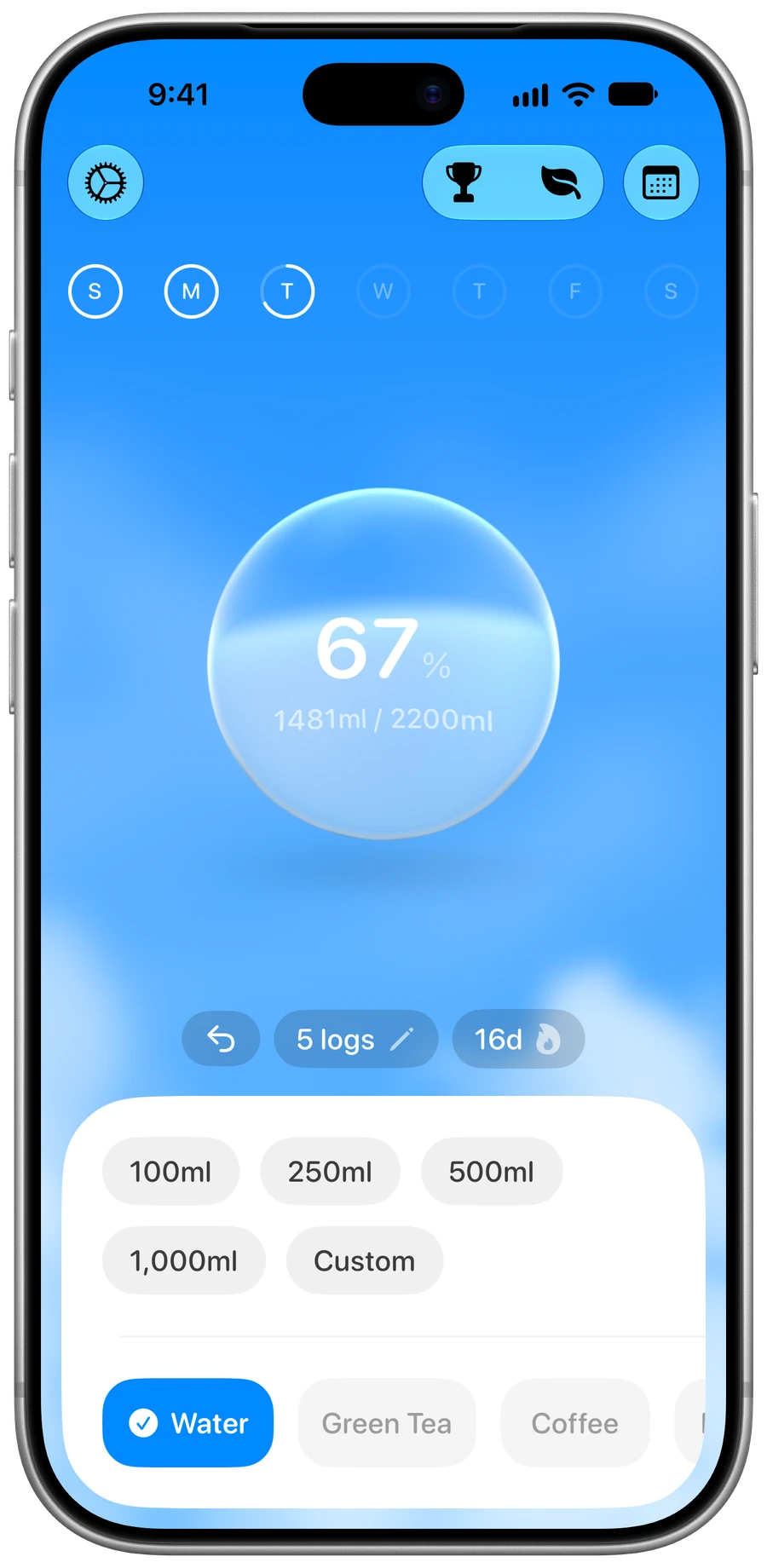
If you want a record of the glasses, rather than a guess at bedtime, Nami logs each drink on iPhone, applies a hydration percent, and keeps a caffeine total beside it. That percent is serving math for what you logged. It is not a lab reading of body water, and it is not a count of days you could go without.
FAQ
How long can you go without water?
MedlinePlus says most people would die in three to seven days with no water intake. A resting-adult model put passive survival at about 3 to 6 days, shorter in the warmth. Heat, hard work, illness, and age can shorten it further. Those figures are not a plan.
How long can a human go without water?
Only for days. Body water is published from about 45 percent to about 75 percent of weight, higher in infants and often lower in older adults. Losses continue after you stop drinking. Watery food is not the same as no water at all.
How long can you live without water?
Living without water and surviving without it are the same short span here: a few days, not a few weeks. Rest in comfort sits toward the long end of three to seven days. Heat, heavy sweat, and gut losses sit toward the short end.
How many days can you go without water?
Three to seven days is the MedlinePlus span when no water is coming in. The 2026 model hit a 10 percent body-mass loss in about 2.5 warm resting days, about 5.9 cool resting days, and about 3 days with gut losses. About 20 percent of an ordinary day's water still comes from food.
How long can a person go without water?
It depends on the person. Infants, children, and older adults lose margin sooner, and thirst gets less reliable with age. Illness, water pills, heat, and heavy work shorten it again. If someone is dying and has stopped drinking, ask their care or hospice team.
For general information only. Not a substitute for advice from a qualified health professional.
- #dehydration
- #hydration
- #water
- #heat
Log the drinks in Nami
Nami is a water and caffeine tracker for iPhone. Each drink counts as a set percent toward the day, and the caffeine total sits beside it. Free to download, with optional Pro.